Rewireable fuses
If your board takes fuse wire and there's a card of spares hanging beside it, it long pre-dates modern protection standards.
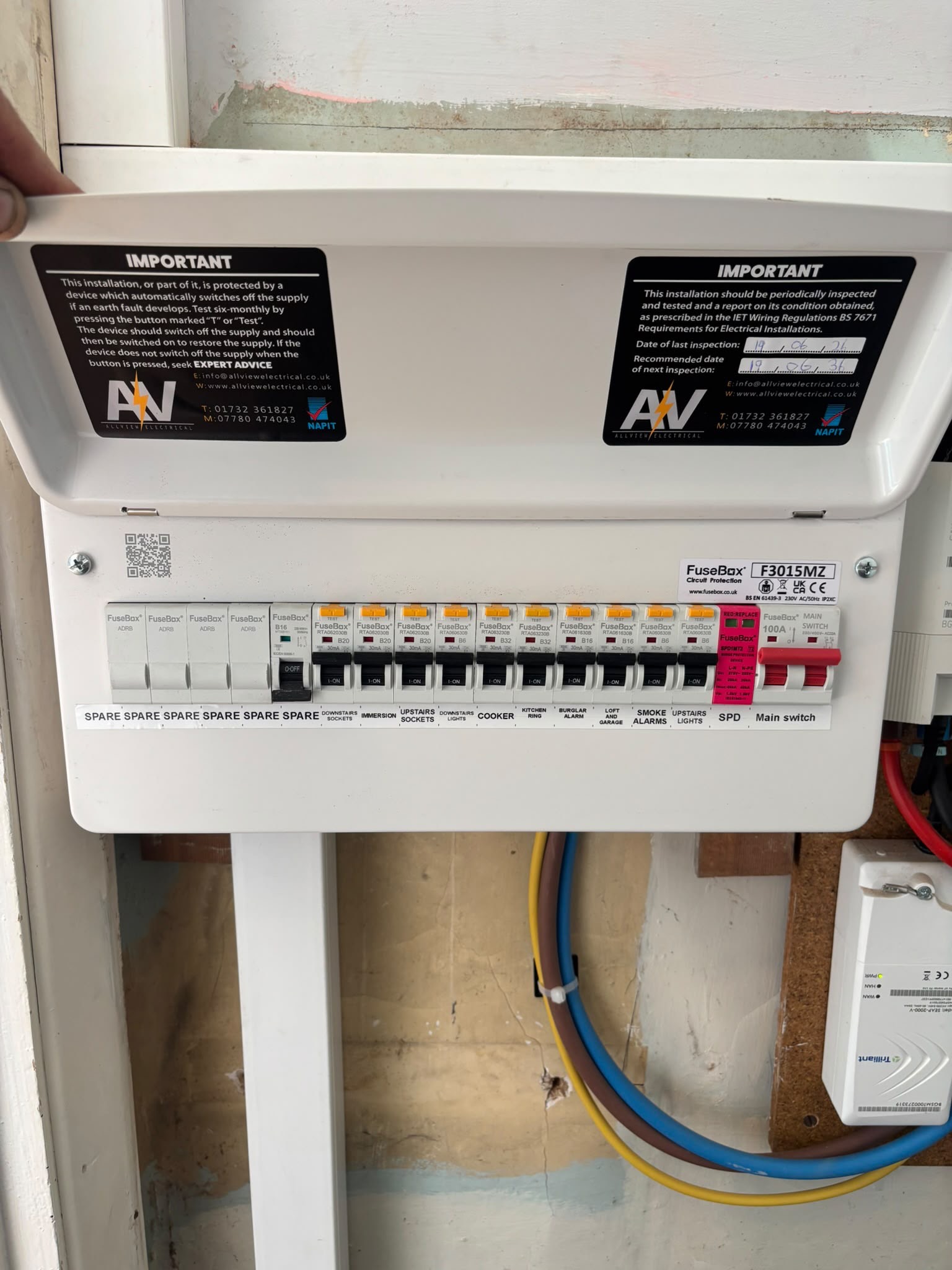
A modern RCBO board, fitted right — safer circuits, surge protection, and the certificate in your hand before we leave.
Your consumer unit decides how quickly a fault is stopped. Older boards with rewireable fuses or no RCD protection react slowly — or not at all. A modern RCBO board disconnects a fault in milliseconds, keeps the rest of the house running, and shields your electronics from voltage spikes.
We inspect your existing board, earthing and bonding, and tell you plainly whether an upgrade is genuinely worthwhile — or whether the wiring behind it needs a full or partial rewire.
The supply is safely isolated, the old board comes out, and a modern 18th Edition unit goes in — wired neatly.
Each circuit is inspected and tested before it's re-energised — so faults are found now, not later.
You receive an Electrical Installation Certificate, and we notify Building Control under Part P for you.
Not every old board needs replacing straight away. These are the things we look for — and if yours is still safe, that's exactly what we'll tell you.
If your board takes fuse wire and there's a card of spares hanging beside it, it long pre-dates modern protection standards.
Without an RCD, a damaged cable or faulty appliance can stay live instead of being disconnected in milliseconds.
A board that trips regularly is telling you something — often a failing circuit, an overloaded way or ageing protection.
Humming, crackling or heat around the board points to loose or failing connections that need attention now.
No spare ways and doubled-up circuits mean your home has outgrown its board — a real problem if you want an EV charger or extension.
C1 or C2 codes against your board on an EICR mean faults need fixing. We'll interpret the report and quote for exactly what's required.
A board upgrade is the best moment to plan for Lutron smart lighting and blinds, because any new circuits can be designed in now rather than added later. We’re Lutron-certified and approved, so the electricians who fit your new board can design, install and set up the system as well. Take a look at our Lutron smart lighting service, or ask us about it when we quote.
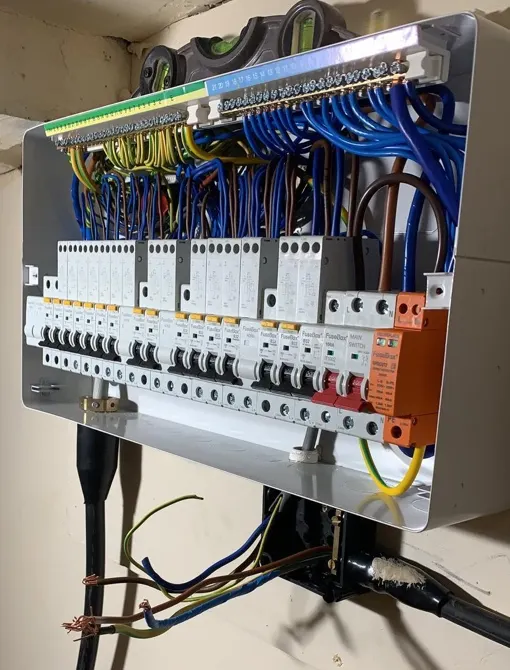
A consumer unit change is priced clearly before we start — no hidden fees, no extras invented halfway through.
A modern metal consumer unit with RCBO protection on every circuit — one fault no longer blacks out the house.
Built-in defence against voltage spikes for your appliances, electronics and smart-home kit.
Each circuit inspected and tested before re-energising, with the results recorded on your certificate.
Your Electrical Installation Certificate issued, and Part P notification handled through our NAPIT registration.
Every way labelled — CCT 01, CCT 02, CCT 03… — so anyone at the board can see exactly what's what.
We inspect your existing board, earthing and bonding, and check the condition of the circuits it feeds.
A clear, itemised quote covering the board, the work and the certification — agreed before we start.
Supply safely isolated, old board out, new RCBO board in — wired neatly and labelled clearly.
Every circuit tested, your EIC issued and Building Control notified — backed by our 12-month labour warranty.
 Which? Trusted Trader
 NAPIT Reg. 62998
Not always — but if your board still uses rewireable fuses, has no RCD protection, or has been flagged on an EICR, it isn't protecting you the way a modern board would. We'll inspect it honestly and tell you whether an upgrade is genuinely worthwhile.
An RCD protects a group of circuits, so one fault can knock out half the house. An RCBO gives every circuit its own combined protection — if a fault occurs, only that circuit trips and everything else stays on. We fit RCBO boards as standard because they make faults easier to live with and easier to find.
A surge protection device (SPD) absorbs sudden voltage spikes — from the grid or nearby lightning — before they reach your electronics. Modern homes are full of sensitive kit, from TVs to boilers to EV chargers, so we include an SPD in every board we install.
Yes — the supply has to be safely isolated while we change the board. For a typical home the changeover and testing is usually completed within a day, and we'll confirm timings before we start so you can plan around it.
There's no law that forces you to upgrade an existing board. But any replacement must meet the current edition of BS 7671 and be notified to Building Control under Part P — and an old board can be marked as unsatisfactory on an EICR, which matters for landlords and house sales. We'll give you straight advice either way.
Yes. Every consumer unit we install is fully tested circuit by circuit and certified with an Electrical Installation Certificate (EIC), and we notify Building Control for you through our NAPIT registration.
We’re based in Tonbridge and fit consumer units across Tonbridge, Tunbridge Wells, Sevenoaks, Hadlow, Paddock Wood and the surrounding villages — part of our full range of electrical services in Tonbridge and West Kent.
Tell us a little about your fuse board and we'll come back with honest advice and a clear fixed quote for the upgrade.